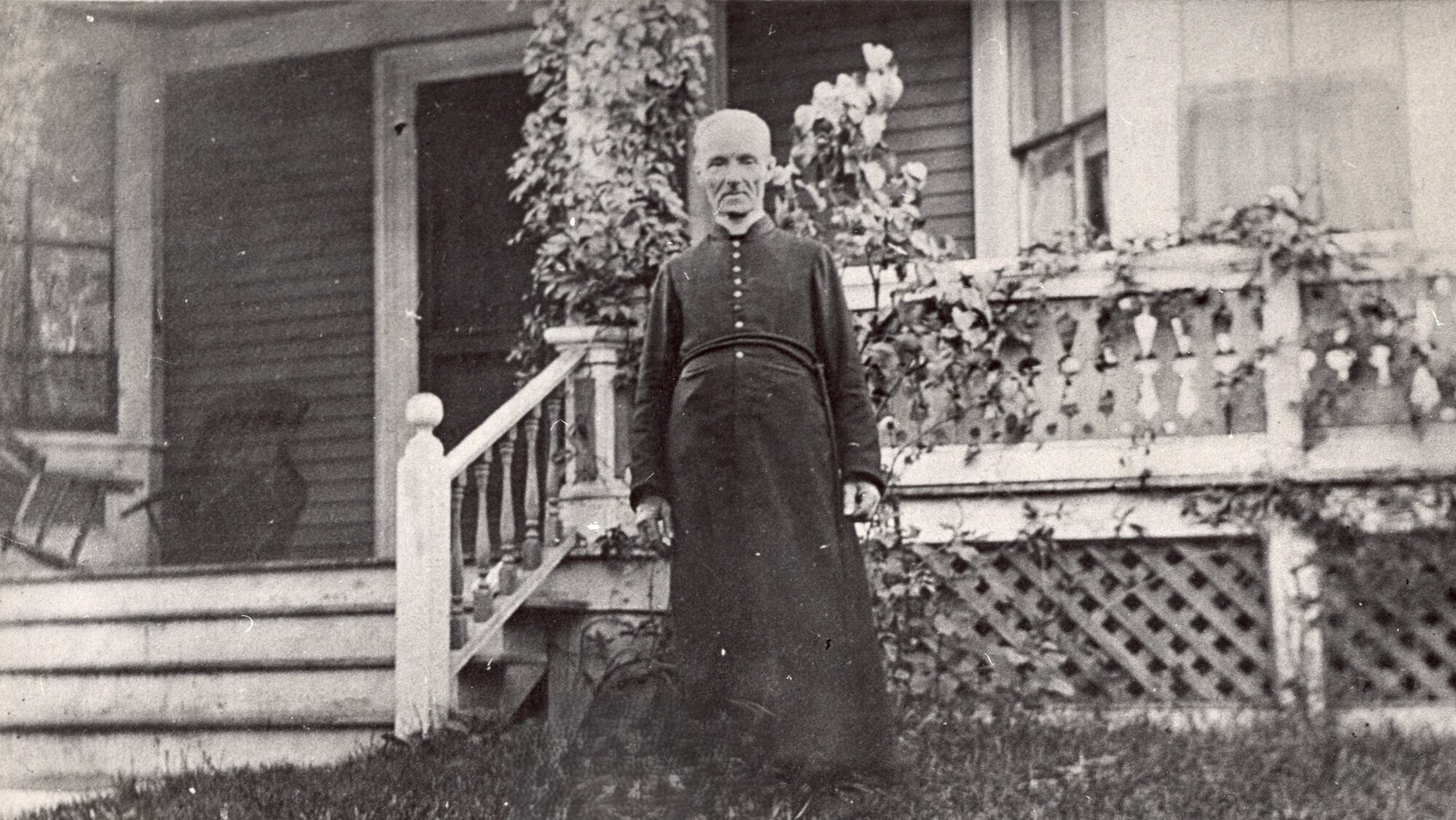
Brother André
In the Records of Our History
Anyone interested in genealogy and history knows that certain official documents contain treasures of information. Among these sources, parish registers as well as Canadian censuses make it possible to portray individuals, families, and society. The figure of a saint, “one of our own,” as Brother André was long affectionately described, also emerges from the pages of these records.
Tracing Alfred Bessette – 1861
Alfred Bessette, who became an orphan at age 11 following the death of his mother in 1857, would know several temporary homes and just as many trades. Research in census records listing the names of all residents of the country allows us to trace him. The 1861 document indicates that Alfred Bessette, age 15, lived in the village of Saint-Césaire, Rouville County, under the roof of Damase Phaneuf and his wife Mathilde Dutilly. Phaneuf worked as a shoemaker; Alfred was a shoemaker’s apprentice, as was Trefflé Parent, age 16. In the 19th century, a shoemaker was an artisan who crafted every part of a shoe, from sole to upper, and followed its wear through multiple repairs.
Brother André in Côte-des-Neiges – 1901
After entering the Congregation of Holy Cross in 1870, it is under the name Brother André that one must attempt to find Alfred Bessette on the Island of Montreal. Searching for a religious name in census records listing citizens by first and last names is more difficult. It is better to proceed indirectly through other known names. For example, priests belonging to the same community as Brother André are duly identified by both first and last names. In the fourth Census of Canada in 1901, in the records for the Jacques-Cartier district and the Côte-des-Neiges Village sub-district, the name “Rev. Brother André” appears on a list of Holy Cross religious.
Rev. Benjamin Lecavalier is identified as superior, Louis Geoffrion as vice-superior; another serves as bursar or accountant, messenger, disciplinarian; several religious are teachers, but only one is porter. And that is Brother André! His identity can be confirmed by his birth date, August 9, 1845, which is also recorded. No mention is made of Notre-Dame College where the 21 religious men enumerated lived and worked, nor of the Oratory, but that goes without saying since it did not yet exist on the mountain facing the educational institution.
Religious of the Oratory – 1931
Thirty years later, during the seventh Census of Canada conducted in 1931—the most recent to have been digitized by Library and Archives Canada—Brother André appears almost at the top of the list on page 1 of the Mount Royal district. The first person named is Father Adolphe Clément, superior of the community of 13 Holy Cross religious residing at Saint Joseph’s Oratory. Added to them are two servants: one a messenger, the other a gardener; as well as four religious sisters from the Little Sisters of the Holy Family (this last detail does not appear in the official document; we add it here for clarification). This time the location is identified, but only as supplementary information written in the left margin of the enumerator’s table.
This census, conducted across the country by the Federal Bureau of Statistics, compiles a large amount of information about individuals and their place of residence. It records the name, sex, and age of individuals, as well as their relationship within the family unit. The birthplace of residents (province or country) is specified, along with nationality, language, religion, and year of immigration where applicable.
One of the 40 columns in the first table contains a brief mention concerning education. The letter “E” is assigned to those who can read and write. This is the case for Brother André and his confreres, most of whom “can speak English” and “can speak French.” The principal occupation of those enumerated and the related industry are included. For Brother André, then 85 years old and dean of the Oratory community, the entry simply reads: “Religious CSC”
Present Day
In April 1931, at the time of the Canadian census, Saint Joseph’s Oratory of Mount Royal was flourishing despite the ongoing economic crisis. Seen from the public road, the site presented a fine appearance with its monument to Saint Joseph erected in 1923 and its landscaped grounds. In the distance, along the mountainside, stood the stone Crypt Church, the residence of the religious, a service pavilion, the tiny original wooden Chapel, and the monumental framework of the Basilica under construction. In this place, which would become the world center of devotion to Saint Joseph, Brother André lived. A remarkable presence spanning the centuries.
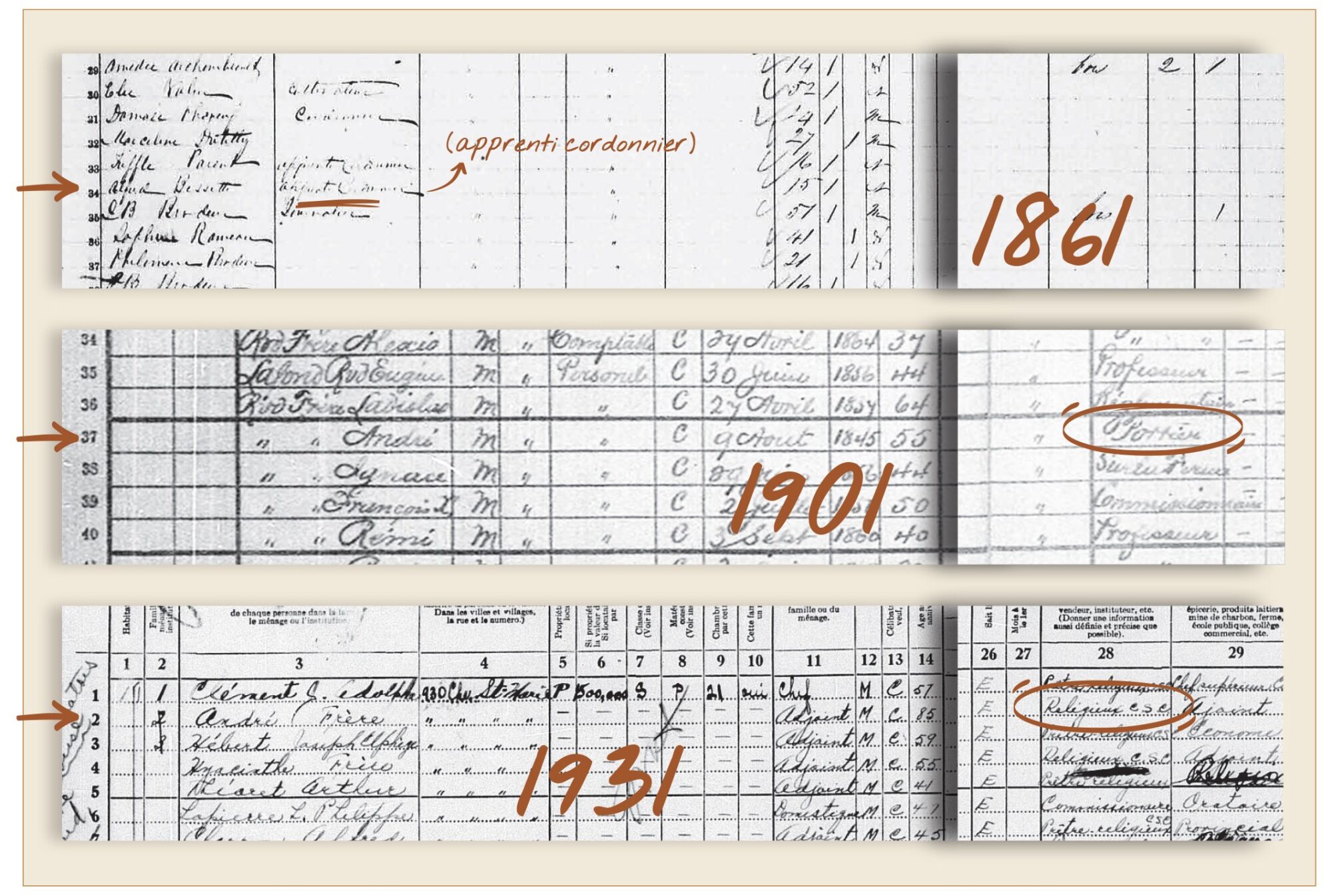
Excerpts from the Canadian censuses of 1861, 1901, and 1931. Source : Library and Archives Canada. Graphic design : Sophie Caron.
*This text first appeared in The ORATORY magazine, July–December 2026, pages 20–22. Reproduced with permission.
*The full versions of the excerpts from the censuses are available on the Library and Archives Canada website via the following links:
1861 – Record information about Alfred Bessette and page from the Census of East Canada of 1861, district 48: Rouville, sub-district 4: Saint-Césaire, page 62 (Source : Library and Archives Canada)
https://central.bac-lac.gc.ca/.redirect?app=census&id=46519255&lang=eng&ecopy=4108823_00133
1901 – Record information about Frère André and page from the Census of the Dominion of Canada of 1901, district 157: Jacques-Cartier, sub-district A : Côte-des-Neiges (Village), page 22 (Source : Library and Archives Canada)
https://central.bac-lac.gc.ca/.redirect?app=census&id=37159177&lang=eng&ecopy=z000141249
1931 – Record information about Frère André and page from the Census of Canada of 1931, district 84: Mount-Royal, sub-district 39: Montreal (City), Mount Royal Ward, page 1 (Source : Library and Archives Canada)
https://central.bac-lac.gc.ca/.redirect?app=census&id=78777712&lang=eng&ecopy=e011618089