History of the Sanctuary Site
In the summer of 1896, Collège Notre-Dame-du-Sacré-Cœur, run by the Congregation of the Holy Cross, purchased the vast hillside property located in front of its gates. This transaction marked the beginning of the devotion to Saint Joseph on the mountain of Mount-Royal. A look back at a real estate saga.
Properties in Côte-Saint-Luc
The first owner of the land was John Ogilvy (1769–1819). His lands extended north and south of Côte-Saint-Luc Road. This road became Queen Mary Road in 1910.
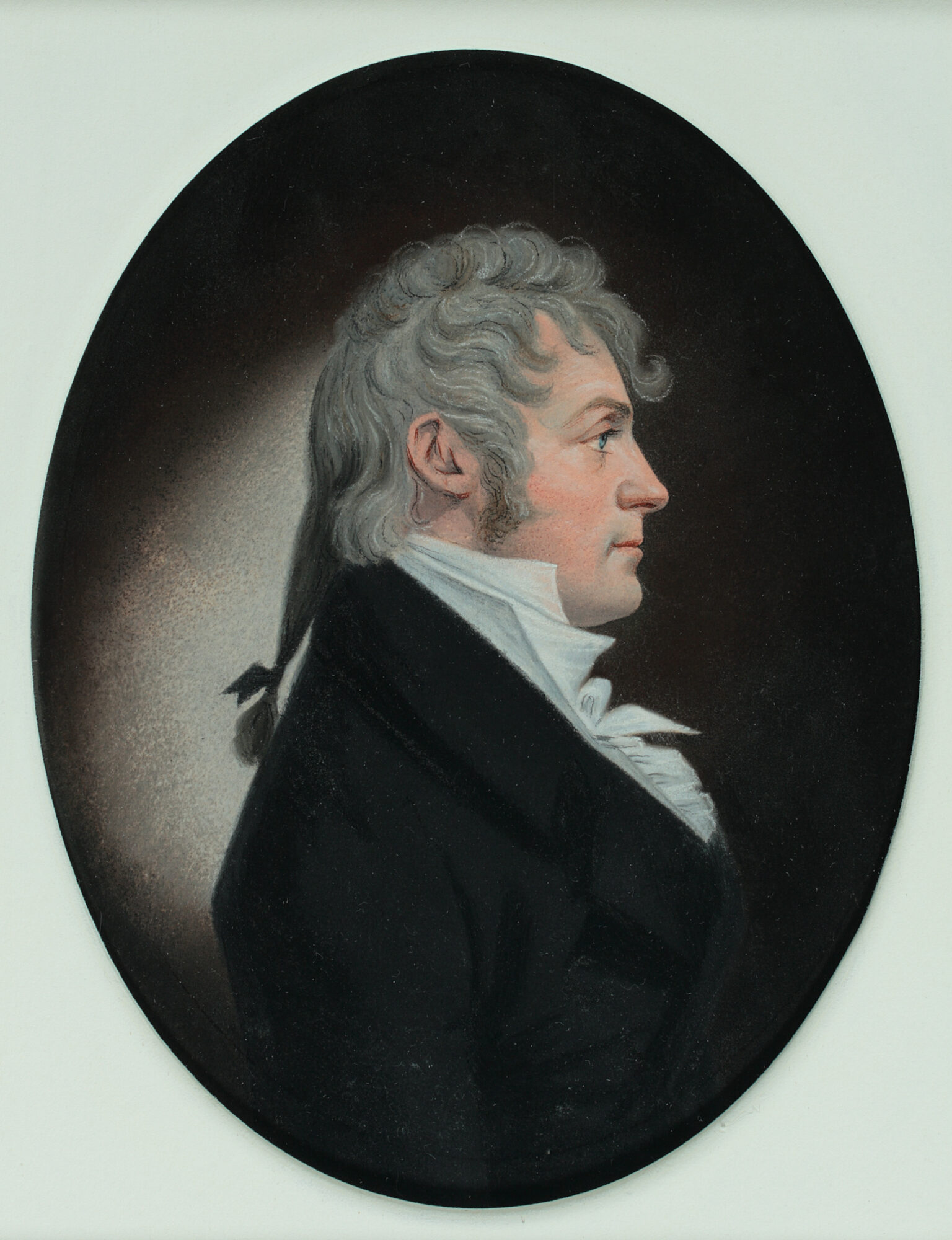
Portrait of John Ogilvy. Gerritt Schipper (1770–1825), circa 1810. McCord Stewart Museum, M321
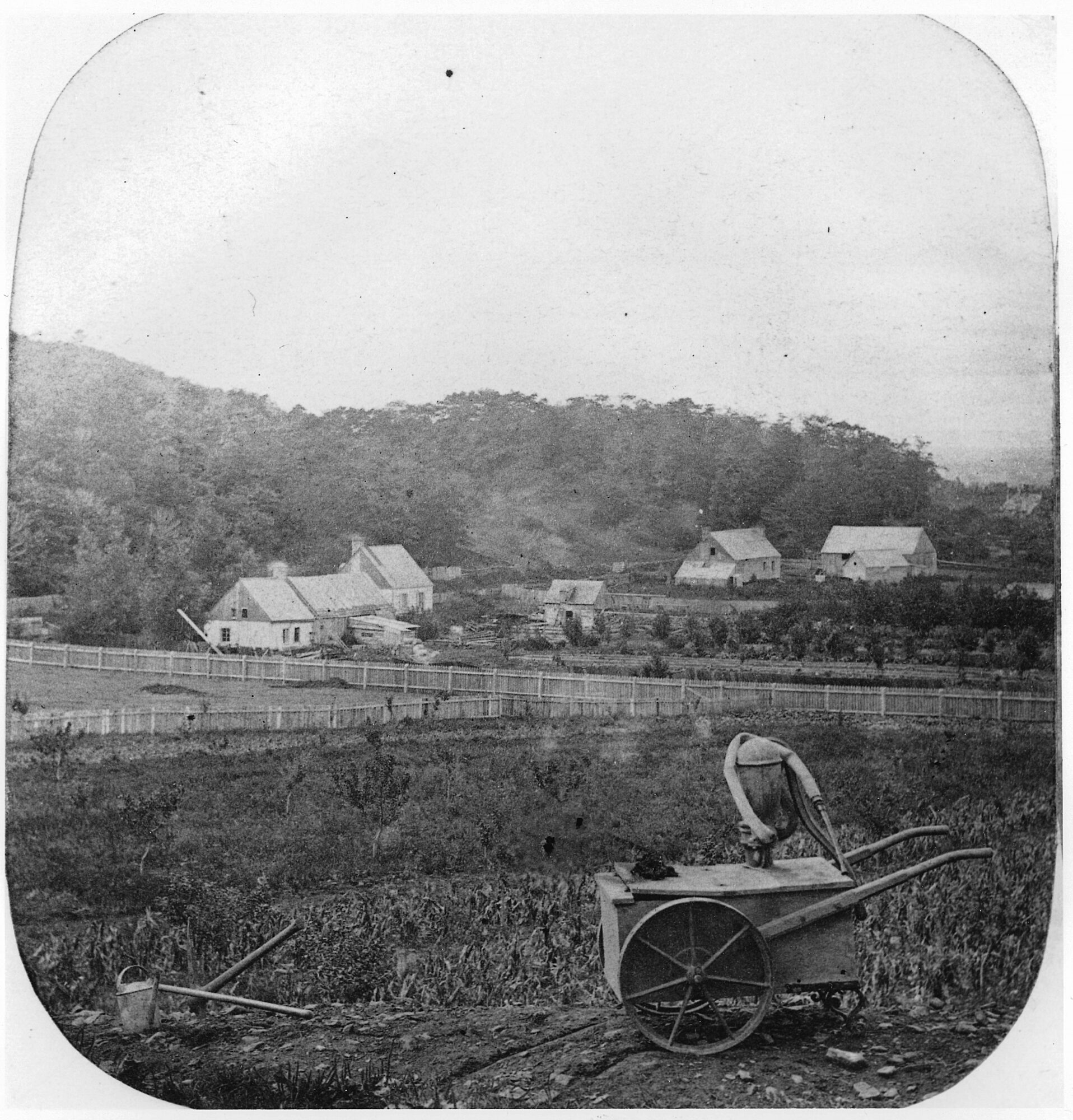
Ogilvy, of Scottish descent, was a merchant, militia officer, and farmer. He purchased this vast estate around 1814 to establish his farmland. In September 1818, one of Ogilvy’s cows was judged the best in its category at a competition held by the Montreal Agricultural Society. The following January, two of his pigs received an honourable mention at an exhibition held by the same society [1].
Upon Ogilvy’s death, the farmland and farm buildings were sold at auction. Colin Robertson (1783–1842), a fur trader, merchant, and politician, purchased the property. Upon his death, it was divided into seven lots. The “lot” that would become the Oratory was purchased by James Blackwood Greenshields. He owned it for less than a year before selling it to Charles-Dewey Day, who immediately resold it to a man named Archibald McFarlane, who remained the owner until 1866.
Meanwhile, the village of Côte-des-Neiges was granted municipal status and experienced rapid expansion. Industries began to set up shop; the land near the mountain was coveted for its fertility; hunting and sports clubs regularly stirred up the woods. A few kilometres away, in the village of Saint-Laurent, a religious teaching congregation was doing everything in its power to find a way to settle there [2].
An Expansion Project
The Congregation of the Holy Cross established itself in Canada in 1847, where it built and operated the Collège de Saint-Laurent. By the mid-1860s, the college had earned a solid reputation, and its financial situation was stable. The Congregation wanted to expand and accepted its first assignment at a boys’ school in Côte-des-Neiges. This venture was short-lived, but it strengthened the Congregation’s desire to move closer to the city, eliminate competition from other colleges, and gain a foothold in a real estate market that was soon to become unaffordable [3].
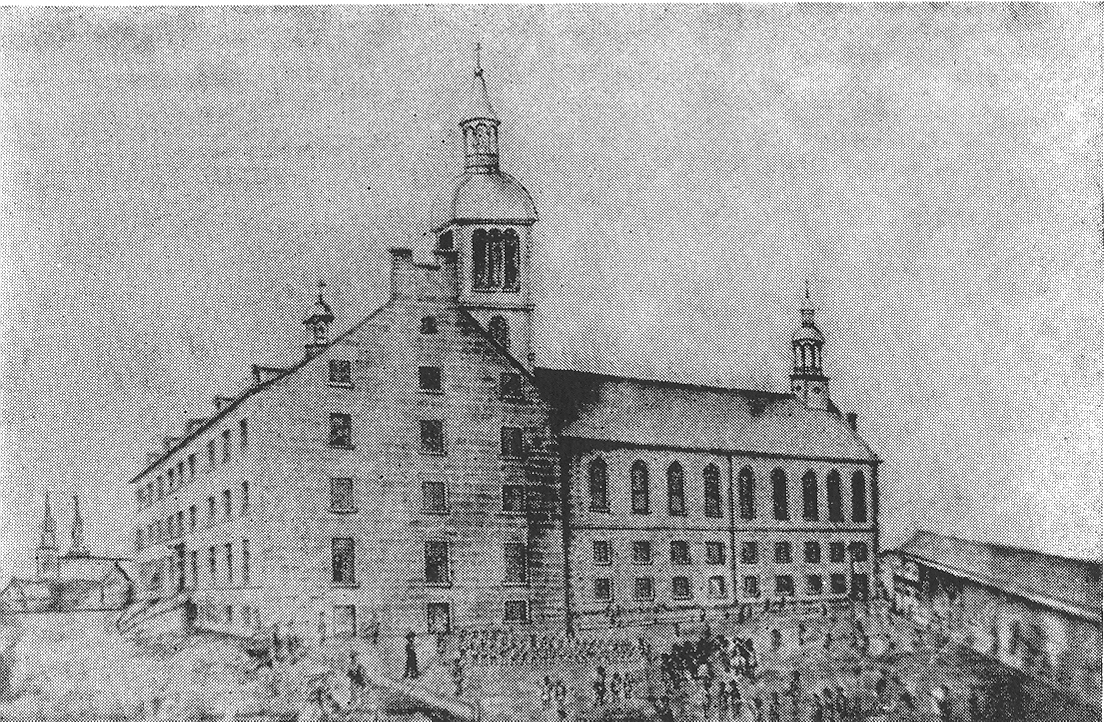
Saint-Laurent College around 1863. Drawing published in the book “1847–1947: The Congregation of the Holy Cross in Canada”
At that time, Collège Saint-Laurent was overcrowded. When word spread that a private hotel in Côte-des-Neiges—the Bellevue—was for sale, the Congregation wasted no time. On September 8th, 1869, three Brothers inspected the property on behalf of the provincial council:
“It is a large wooden building, rustic in appearance, about sixty feet wide, with a ground floor and one upper story, surrounded by apple trees and wild shrubs. Colonnades, made of wood like the rest of the building, adorn the portico and give it a certain charm.” [4]
The purchase was made without the direct approval of Bishop Bourget, who was in Rome at the time. Authorization was granted by the vicar general. Bishop Bourget himself objected, but the transaction was completed for $9,000 [5].
A few selected Brothers settled in Bellevue Hotel on October 6th, 1869. The Collège Notre-Dame-du-Sacré-Cœur would receive “young students”—those aged 7 to 12. The school taught French and English, reading, writing, basic arithmetic, history, and geography, as well as religious instruction [6].
The school opened with 24 students on November 4th, 1869, 14 of whom came from Saint-Laurent [7].
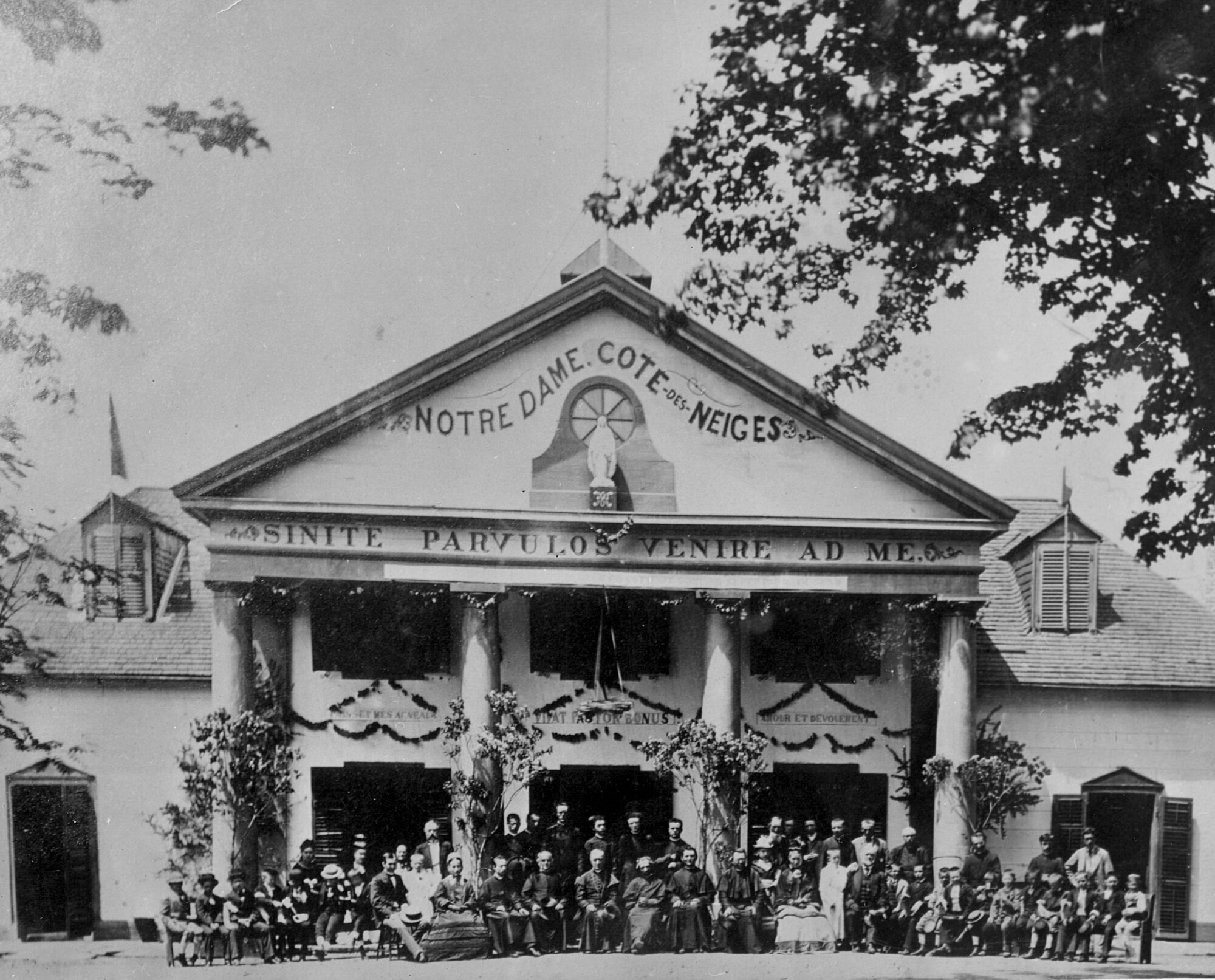
Notre-Dame-du-Sacré-Cœur School. Date unknown. Photographer unknown. OSJ Archives, 009-7
The Congregation’s novitiate also moved to Côte-des-Neiges. On November 22nd, 1870, Alfred Bessette was admitted as a postulant. His novitiate began on December 27th. He received his first assignments a year later. He was assigned the duties of doorkeeper, lamp tender, caregiver, and was responsible for mopping the floors of the chapel, hallways, rooms, staircases, etc. He also had to carry—or arrange for others to carry—firewood for heating [8].
In 1871, a floor was added to the Bellevue Hotel. The Superior General of the Congregation, Fr. Édouard Sorin, C.S.C., visited the institutions in Canada in September and foresaw a brighter future for Notre-Dame than for Saint-Laurent [9].
While things were going fairly well for the College, the same could not be said for Alfred Bessette, who was deemed too unhealthy to be admitted to religious life. But Fr. Amédée Guy’s, C.S.C., intervention on behalf of the young novice would change everything. It was Fr. Guy who famously said, “If he becomes unable to work, at least he will be able to pray well.” Alfred took his temporary vows in August 1872 and his perpetual vows on February 2, 1874. From then on, he would be known as Brother André [10].
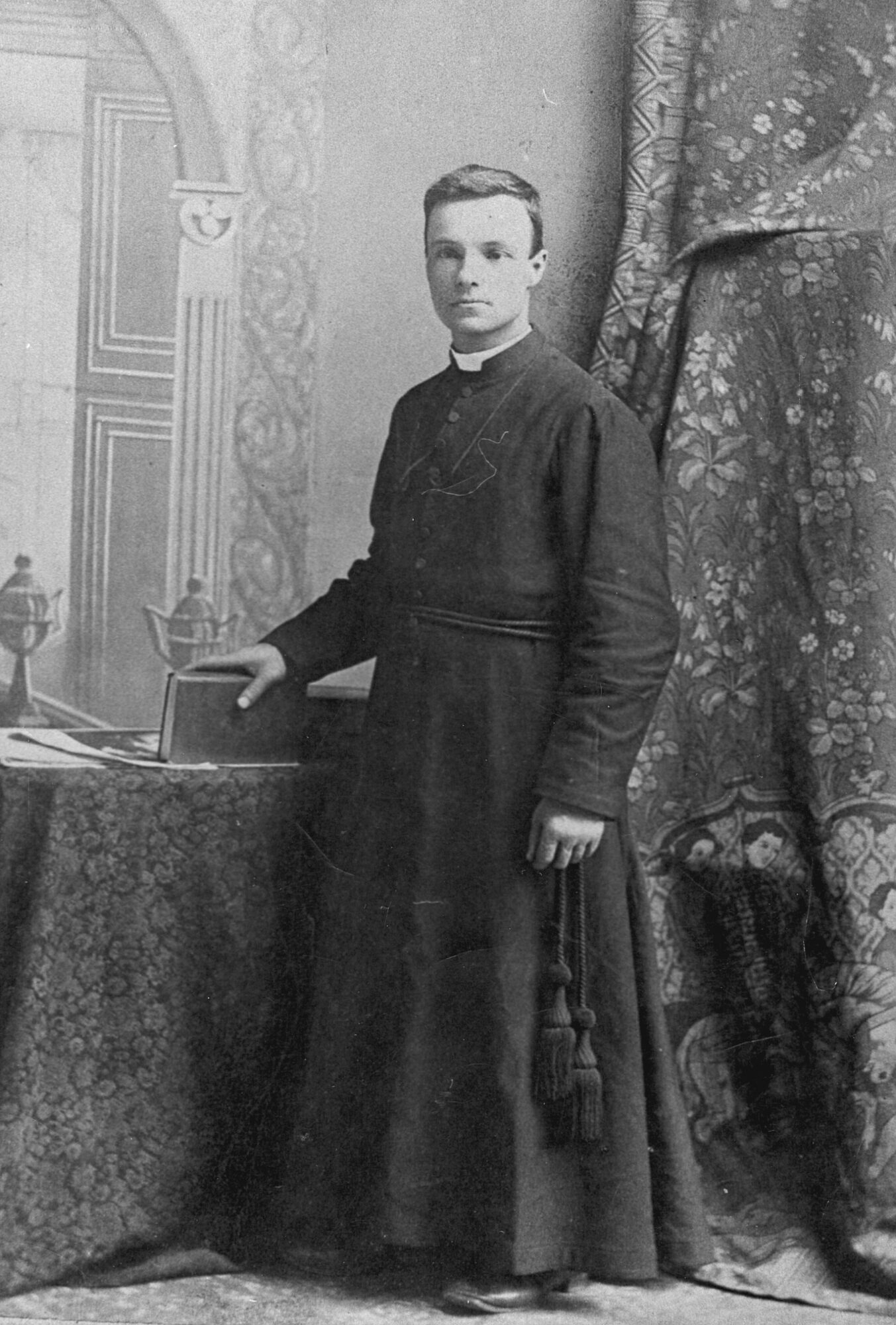
Brother André, C.S.C., in February 1874. Photo: Henri Larin. OSJ Archives 005-1
Joseph MacKay wants to sell his property.
The College had no plans to purchase the mountain property at that time, but the opportunity arose in 1877.
The owner of the land was John Joseph MacKay (1810–1881), a pillar of Montreal society. Having arrived from Scotland in 1832, he made his fortune trading in bulk goods with his brother. He was one of the founders of the Presbyterian College of Montreal, whose missionary activities he supported financially as soon as he was able. Together with his brother, he took a personal interest in the Protestant institution for the deaf and mute: he donated a plot of land on Décarie Boulevard and had a four-story building constructed at his own expense. This institution would become the Mackay Centre for Deaf and Crippled Children, now known as the Lethbridge-Layton-Mackay Rehabilitation Centre.
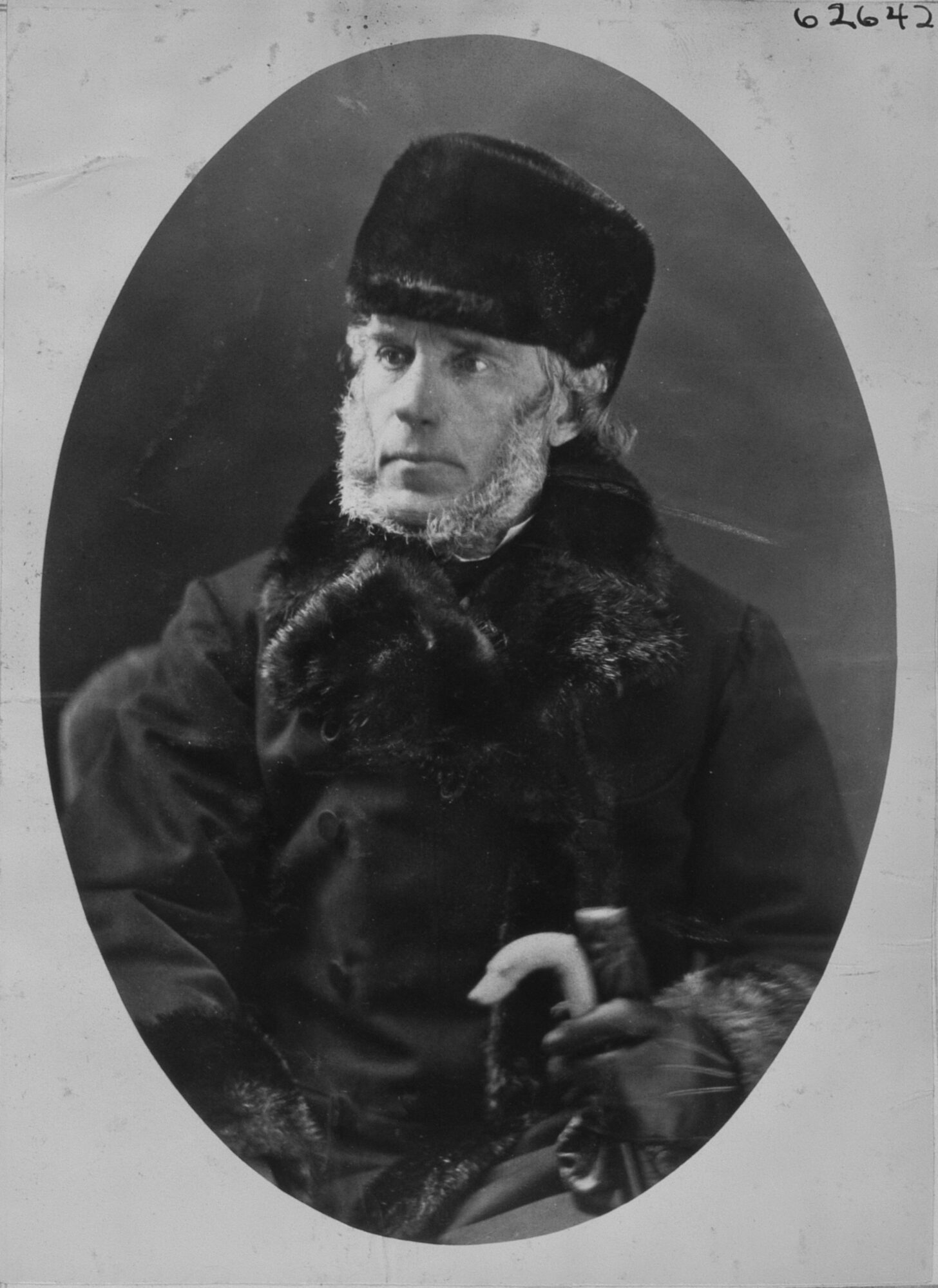
John Joseph MacKay, Montreal, QC, 1871. William Notman (1826–1891). McCord Stewart Museum. I-62642.1
The College was eager to purchase Mackay’s land to expand its agricultural grounds, gain easy access to the mountain, prevent the establishment of “unwelcome neighbours” such as roadside bars, inns, or sports clubs, and also secure space for future growth. Unfortunately, the College’s financial situation was deemed too precarious. The land was sold to a speculator, Alexander Gunn, for $3,250 in July [11].
But it is an entirely different event that is causing quite a stir in the hallways of Collège Notre-Dame. Br. Aldéric (Désiré Giraudeau), C.S.C., one of the pioneers of the Congregation in Canada, published the first accounts of healings associated with St. Joseph’s oil in the Annales de l’Association de Saint-Joseph. Br. Aldéric discusses Brother André’s role in these healings in the June 1878 issue. “This was the first event to draw attention to Brother André’s abilities. The healings attributed to his prayer, the oil, and the St. Joseph medal would spread exponentially…” [12].
You can’t buy it, but you can expand it.
In 1881, it was decided to demolish what remained of the Bellevue Hotel to make way for a modern building capable of accommodating 200 students, complete with running water and central heating. Under the leadership of Fr. Augustin Louage, C.S.C., the foundation stone was laid and the construction site was blessed on March 19th. In the fall, Brother André moved into the famous “janitor’s room,” a space that still exists today at Collège Notre-Dame [13]. The new building was, for all intents and purposes, completed in December 1881 [14].
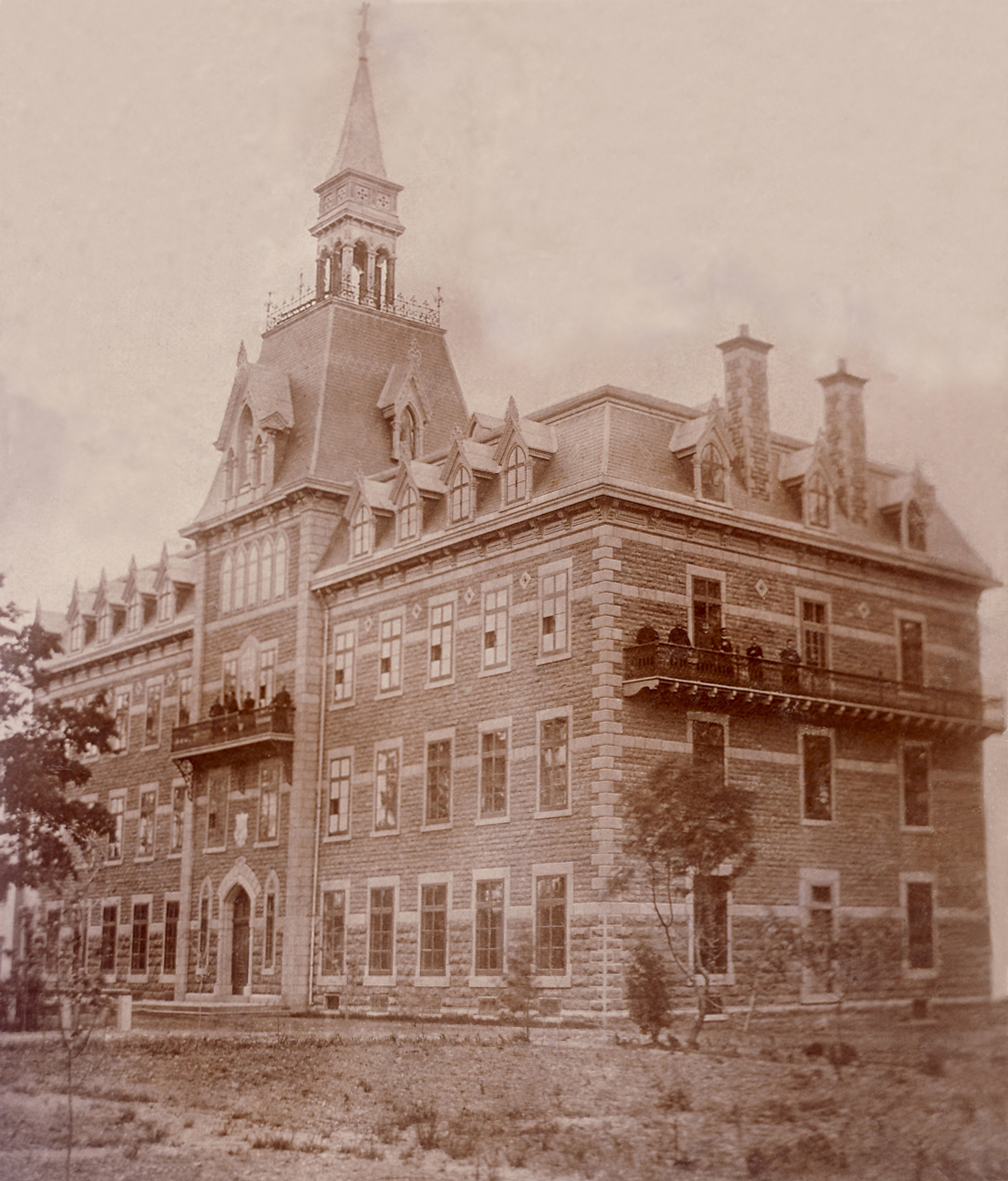
The new wing of Collège de Notre-Dame, after 1881. Photographer unknown. Collège de Notre-Dame Archives
Did the College’s new building lead Alexander Gunn to believe that the institution was now wealthier? It seems likely, since in 1883 Gunn offered to sell the land to the College for $12,000. In December 1884, the College made a counteroffer of $9,000. Gunn refused and even raised the price of the property to $15,750. The negotiations went no further [15].
Three years later, in 1888, a rumour spread that a hospital for smallpox-infected patients was about to be established on a property adjacent to the College—the McGregor farm. Fr. Louages immediately ordered the purchase of the property for $4,400. That same year, the College purchased the vast 1 250 000 square foot plot of land from a neighbouring farmer, Hormidas Desrosiers [16].
The College’s fears came true in 1893 when Gunn sold the eastern half of his property to the Athletic Club of Montreal. The other half was purchased by a man named Michael Guerin for $8,000 [17].
Time has Finally Come
Guerin does not appear to be building anything or living on his plot of land. In the spring of 1896, a “For Sale” board is posted on the front of the property, advertising it for $12,000 [18].
Br. Aldéric, now the College’s bursar, considered the proposal. He entrusted the matter to Saint Joseph: it is from this event that the anecdote originates, according to which some members of the religious order (Brother André? Father Geoffrion?) went to the highest point of the property to bury a medal of Saint Joseph beneath the roots of a pine tree. On May 18th, 1896, negotiations began.
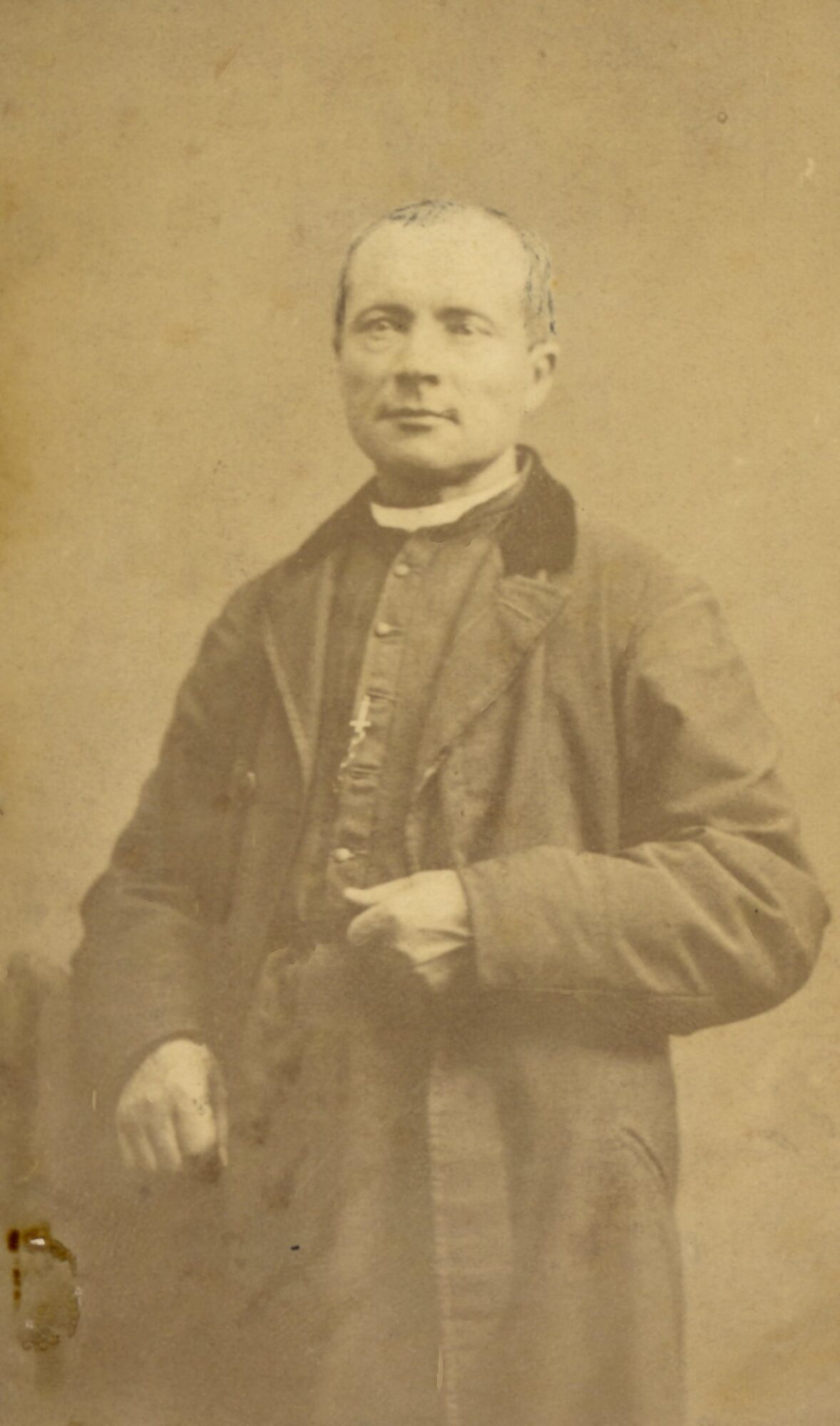
Brother Aldéric (Désirée Giraudeau), C.S.C., 1877. Photographer unknown. Provincial Archives of the Fathers of the Holy Cross, Q059
After “spending a long time” at the chapel, Br. Aldéric proposed to the provincial council that they purchase the Guerin property. The seller agreed on a price of $10,000 in cash. The debts from the major construction projects at the College had been sufficiently paid off, and the transaction seemed feasible. At the rate the city is developing, the mountain will be surrounded by the time ten years have passed. As proof, the two properties adjacent to the Guerin lot are valued at $20,000. Property prices will rise accordingly, and it will be absolutely unthinkable to buy at that price [19].
The board believes the land will be very profitable for the school: vegetables will be grown there, and the surplus will be sold at public markets; the stone will be sold for road construction; the land will serve as a space for recess and future construction projects [20]. They requested and received approval from the Congregation’s general administration on July 16th, 1896. Fr. Geoffrion signed the deed of purchase before a notary in the college’s parlour on July 22nd.
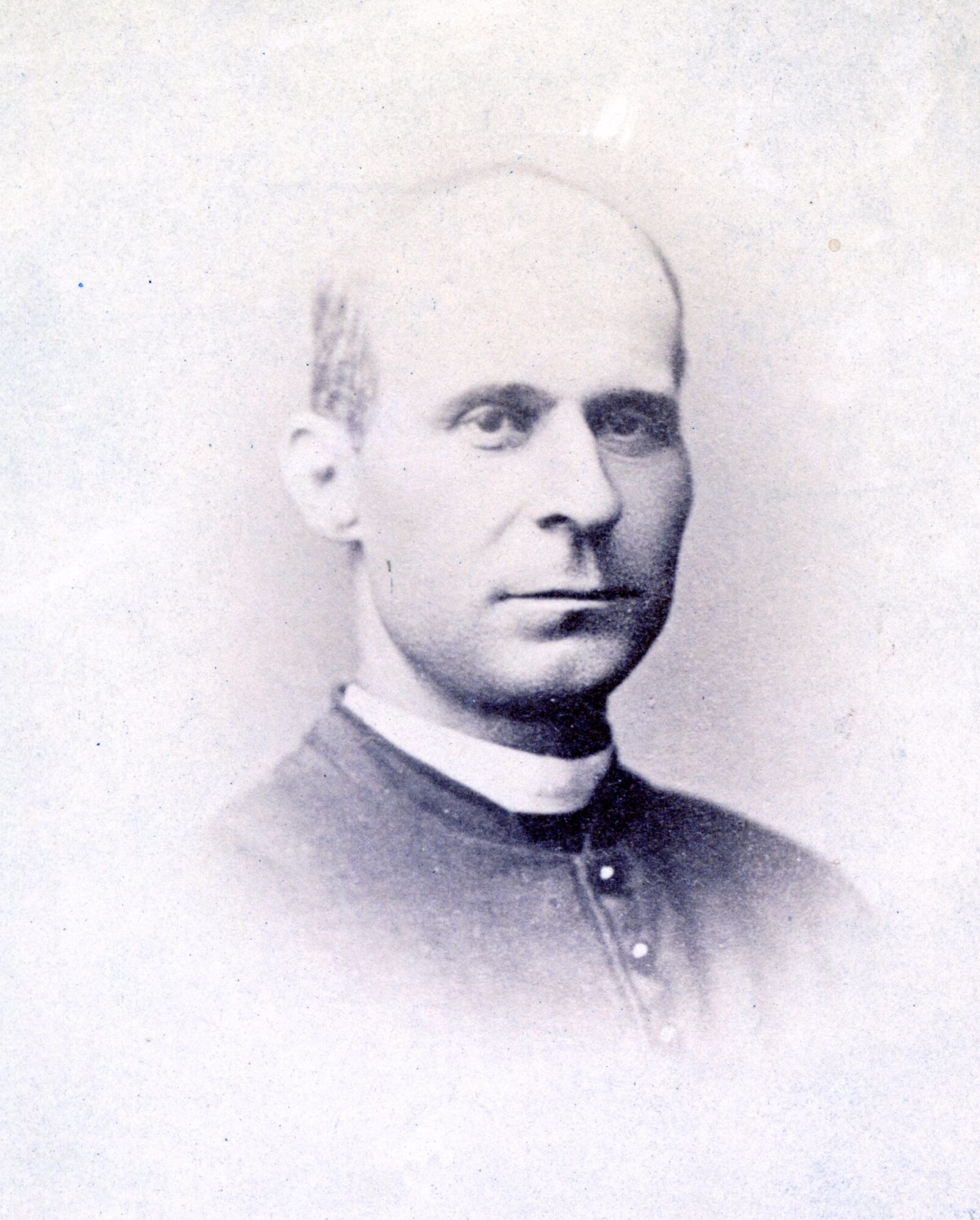
Father Louis Geoffrion, C.S.C. Date unknown. Photographer unknown. Provincial Archives of the Fathers of the Holy Cross, Q199
The famous mountainside property measures roughly 552 000 square feet. Rectangular in shape, it extends from the Côte-Saint-Luc road to the top of the mountain [21]. Within days of the transaction, a path was cleared and a small promontory was built: this is “Boulevard Saint-Joseph” and its “Parc Saint-Joseph.”
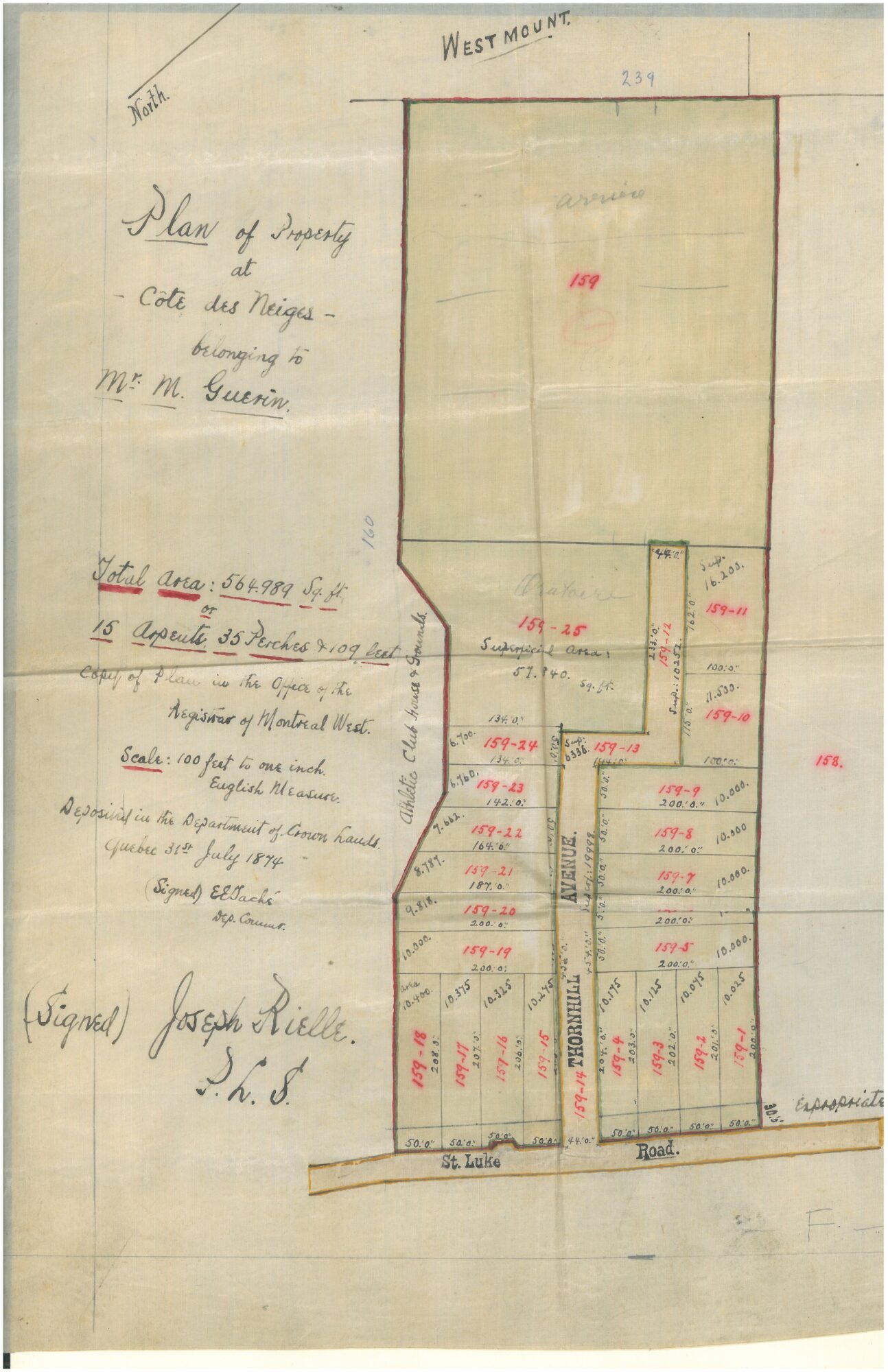
Map of Mr. Michael Guerin’s Properties. OSJ Archives, 050100/3750_QueenMaryRoad
The Oratory is Still a Dream.
In 1898, the Congregation of the Holy Cross celebrated its 50th anniversary in Canada. That same year, Br. André hung a small statue of Saint Joseph, along with a collection box, in a natural crevice in a cliff on the property. He was often seen going up there to pray during his free time. He also invited some visitors on pilgrimage to go to the rock to pray to Saint Joseph.
Br. André’s health forced him to rest for a few days. Providence saw to it that Fr. Benjamin Lecavalier, C.S.C., his superior, happened to be in the infirmary. “During those interminable hours of forced rest, Brother André tirelessly pleaded his case, so much so that he obtained permission to build a tiny chapel on the mountainside.” [22]. However, neither the College nor the Congregation will contribute financially to this project.
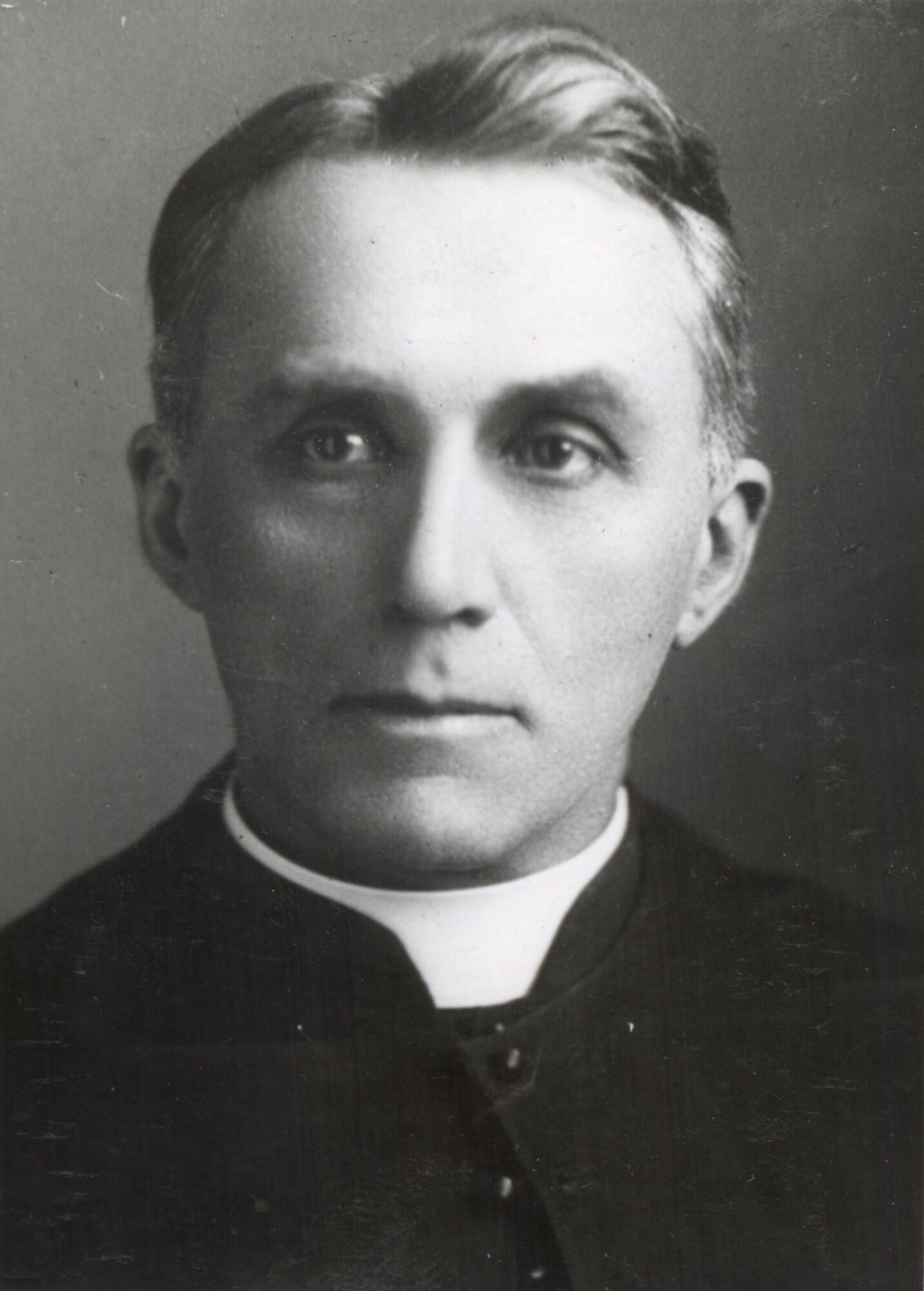
Father Benjamin Lecavalier, C.S.C. Date unknown. Photographer unknown. Provincial Archives of the Fathers of the Holy Cross, Q207
Fr. Lecavalier gave Br. André permission to keep the donations collected in the collection box on the cliff. These funds would be added to the money raised from the students’ haircuts at the college to help build a small chapel on the mountain [23].
It took six years to raise the $200 needed to build the first chapel. The College would take the necessary steps to obtain Bishop Bruchesi’s approval. They would also allow Br. Abundius, the college’s carpenter, to work on the construction in his spare time: it would take seven to eight days of work to build the sanctuary’s first chapel in 1904. Saint Joseph, after many twists and turns, finally had his mountain [24].
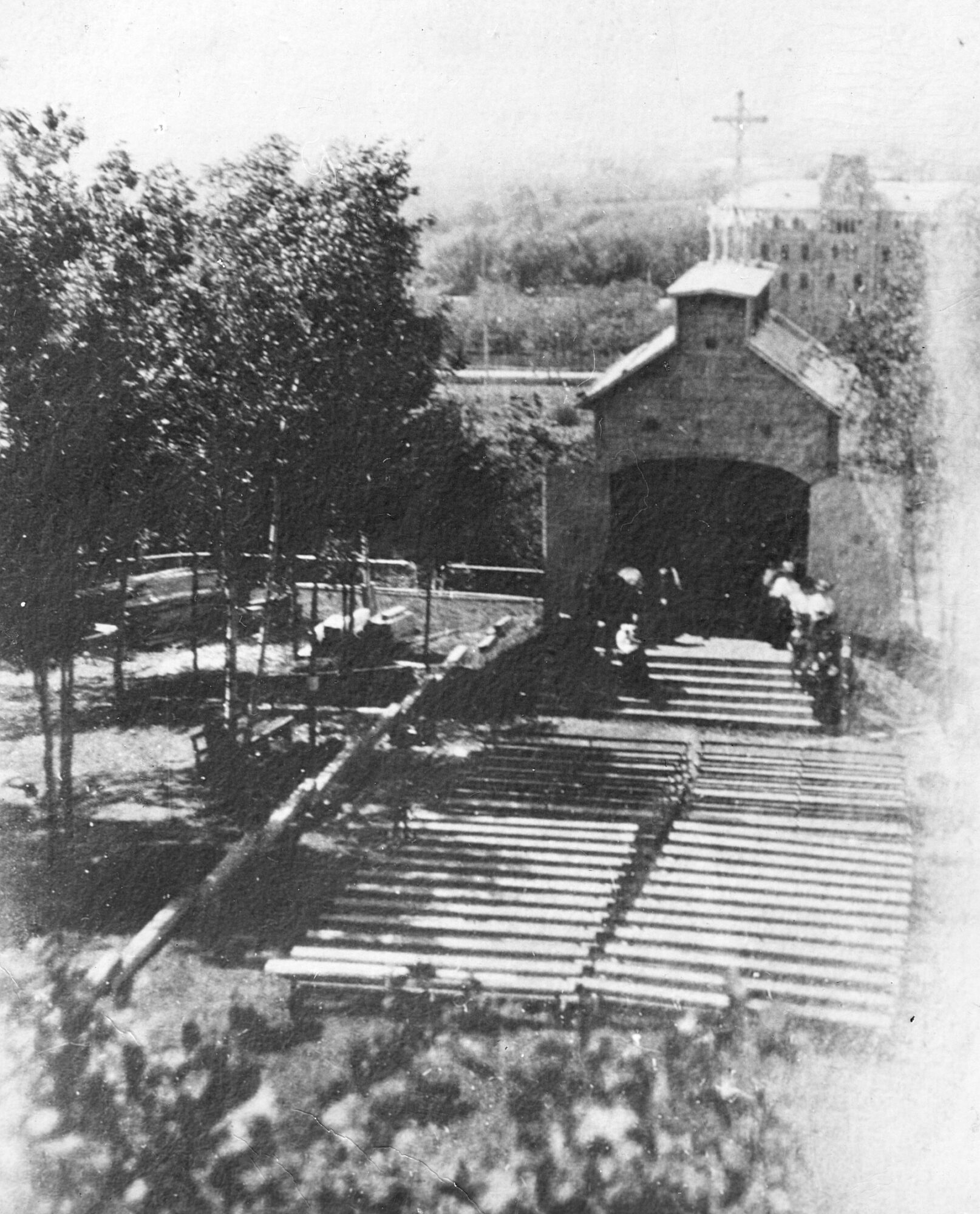
The Original Chapel, circa 1905. The west wing of Collège Notre-Dame is visible in the background. Photographer unknown. OSJ Archives, 028-4
[1] Dictionary of Canadian Biography : Ogilvy, John.
[2] Rumilly, 36
[3] Rumilly, 36-37
[4] Idem
[5] Sainte-Croix au Canada, 234
[6] Rumilly, 39
[7] Boucher, 19
[8] Ibid., 15-16
[9] Rumilly, 59
[10] Boucher, 17-18
[11] Trottier, juin 1963, 26
[12] Boucher, 23
[13] Boucher, 20
[14] Rumilly, 84. Le père Augustin Louage est le supérieur de 1880 à 1888. Nombre de religieux se plaignent de son humeur et de son caractère difficile, voire colérique. Le frère André est reconnu pour subir les foudres du supérieur, recevant le surnom de « paratonnerre » du Collège.
[15] Trottier, op.cit.
[16] Rumilly, 87-94
[17] Boucher, 29
[18] Robillard [version numérique] 18-19
[19] Rumilly, 103
[20] Catta, 222
[21] Saint-Pierre, 52
[22] Lachance, 52
[23] Boucher, 32
[24] Boucher, 32
SOURCES
Boucher, Laurent c.s.c. Le bienheureux Frère André religieux de Sainte-Croix : Le Thaumaturge de Montréal. Province des Frères de la Congrégation de Sainte-Croix, 2004.
Catta, Étienne. Le frère André : 1845-1937. Fides, 1965
Congrégation de Sainte-Croix. 1847-1947 : Cent ans de la Congrégation de Sainte-Croix au Canada. Fides, 1947
Lachance, Micheline. Le frère André : l’histoire de l’obscur portier qui allait accomplir des miracles. Les Éditions de l’Homme, 2004.
Robillard, Denise. Les merveilles de l’Oratoire, 1904-2004. Fides, 2005.
Rumilly, Robert. Cent ans d’éducation 1869-1969 : Le Collège Notre-Dame. Édition Fides, 1969.
Saint-Pierre, Arthur. L’Oratoire Saint-Joseph. Oratoire Saint-Joseph, 1926
Trottier, Aimé, c.s.c. « L’achat du terrain de l’Oratoire », dans Revue L’Oratoire, juin 1963.